Have you ever watched a Taekwondo demonstration and felt amazed by the power, grace, and precision behind every move? Taekwondo demonstration is to display the Taekwondo techniques and feats achieved by Taekwondo practitioners, thereby making the spectators interested in, encouraged, and motivated to learn Taekwondo training after understanding what it is.
Taekwondo demonstration can be defined as an integral art of Taekwondo performed by Taekwondo experts by showing for a short period of time what they have so far studied and practiced, such as basic motions,poomsae,kyorugi,kyokpa(breaking ), self-defense, special techniques, and feats.
What Is a Taekwondo Demonstration?
A Taekwondo demonstration helps develop and propagate Taekwondo as it encourages and motivates the spectators to understand the true entity of Taekwondo and to have intertest in learning it.There are no fixed rules, but audience, required time and site environment must be taken into consideration for preparation of a demonstration.
Types of Taekwondo Demonstration
Taekwondo demonstration is divided into an Individual demonstration and Group demonstration.
Individual Taekwondo Demonstration
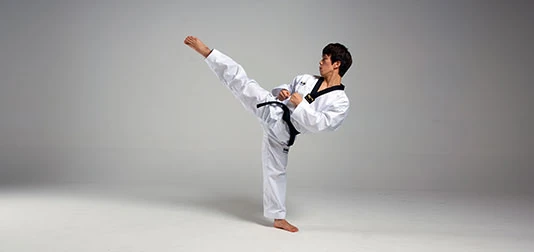
The Individual demonstration is usually conducted on the occasion of opening one’s own club or dojag as a means of introducing himself/herself, or breifly or simply for one’s self display of techniques. There are various restrictive conditions in performing an individual demonstration because it usually aims at showing an individual taekwondo expert’s feats for private purposes on the occasion of opening a club or dojang.
Group Taekwondo Demonstration
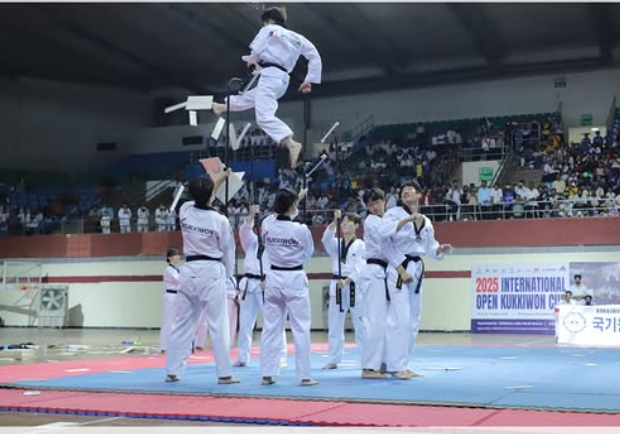
A Group Demonstration, which consists of more than two demonstrators, can display an integral art of Taekwondo techniques by performing various different types of feats respectively by each expert of a particular specialty, in addition to showing of powerfulness,self-defense art, game competition and other special techniques. The group demonstration is classified into three categories as follows:
Demonstration by a Taekwondo Demonstration Team
This is a principal form of demonstration conducted by a designated Taekwondo demonstration team, which consists of 20 to 30 selected members, to display overall Taekwondo techniques, including composition of demonstration, basic motions,poomsae,kyorugi, self-defense art,kyokpa, competition and special techniques. This type of demonstration is assigned to introduce Taekwondo at a stadium before VIPs or a particular audience.
Mass Game Style Taekwondo Demonstration
This is characterized by a large number of participants in the demonstration,e.g., over 500 to 1,000 demonstrators. This form of demonstration is usually organized as a pre-event program or the last program of big events like sports meets.
Rhythmic Taekwondo Demonstration
This demonstration is designed to show children, girl students and ladies the rhythmic movements of Taekwondo basic motions, poomsae, and kyokpa in the form of a dance, keeping time to the music. There are two kinds of rhythmic demonstrations: one is the contemporary dance rhythmic taekwondo demonstration, and the other is the “sadaenori” dance rhythmic Taekwondo demonstration, which symbolizes an ancient Korean folk dance.
Contents of Taekwondo Demonstration
The contents of Taekwondo demonstration may differ according to the scale, time, and place of demonstraion,but the following are the essential items to be included in the organization of Taekwondo demonstration.
- Warming-up exercise: An appropriate and simple warming-up exercise is also applied to the Taekwondo demonstration.
- Basic Motions: A adequate of certain basic motions of taekwondo must be included in the demonstration program.
- Poomsae: Display of one or two selected poomsae among the simple Kup-grade poomsaes and the difficult Dan-grade poomsaes.
- Kyorugi: The kyorugi demonstration may include the one-time and three-time kyorugi and martial art kyorugi, that is 1:2,1:3 kyorugis and competition-type kyorugi.
- Kyokpa: The golden item of Taekwondo demonstration is kyokpa(breaking), which may be classified into a feat kyokpa and a power kyopha.There are yet chances for studies and development of better techniques for a kyokpa demonstration.
- Self-defense Techniques:This demonstration can be divided into bare-hand self-defense and rifle-and-bayonet self-defense, and it is recommended to differentiate the contents of demonstration according to the male and female,and adults and students.
Top FAQ’s
1.Are Taekwondo demonstrations part of the Olympics?
Taekwondo is an Olympic sport; however, demonstrations are not part of the actual competition. But the World Taekwondo Demonstration Team often performs at big events to spread the word about the sport around the world.
2. Why do Taekwondo demonstrators shout during performances?
Kihap is the name of the yell(shout) that gives you more power and focus. Not only does it look good, but it also helps practitioners focus their energies, strengthen their core muscles, and scare off imaginary enemies. Kihap is a part of every Taekwondo demonstration that shows strength and confidence.
3. What’s the hardest part of performing a Taekwondo demonstration?
The toughest challenge is synchronization under pressure. Even one mistimed move can break the rhythm, so constant group practice and trust are crucial.
Conclusion
In my view, Taekwondo demonstrations are one of the most beautiful ways to showcase the harmony between strength and spirit. They’re not just about breaking boards or high kicks — they’re about breaking limits. The art form builds confidence, discipline, and pride in every practitioner.
While the physical and mental challenges are real, the rewards far outweigh them. Every demonstration tells a story of persistence and excellence. If you ever get the chance to perform or witness one, don’t miss it — because in that moment, you’re not just watching martial arts, you’re witnessing the heart of Taekwondo itself.
1 thought on “What Makes Taekwondo Demonstration So Impressive?”